
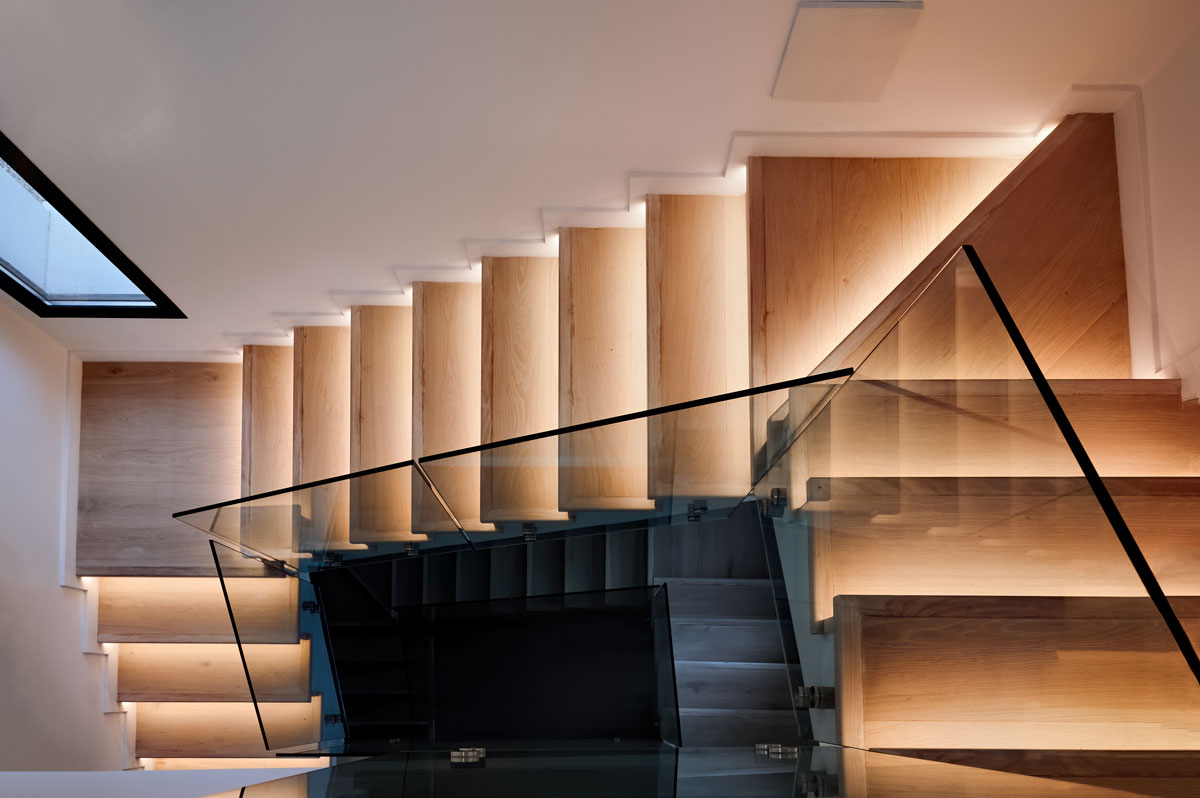
A staircase is not only an important architectural feature that immediately draws attention, but also an essential functional element that determines how comfortable daily movement between floors will be. By construction type, staircases can be straight-flight, spiral, or helical. Each defines a specific path of movement and can be made from different building materials, with various structural support systems for the treads. Let’s review the key factors to consider when choosing an interior staircase.
1. Choose the staircase type with comfort and safety in mind
Each staircase type has its own advantages and disadvantages. In terms of safety and ease of use, straight-flight staircases are generally considered the most comfortable, since movement follows a straight path. However, they require more space, which depends on the size of your home. Spiral staircases are more compact and guide movement along a curved path. Helical staircases also form a spiral but around a central axis; they are less convenient and safe, yet they save space and can be more budget-friendly.
2. Plan the railing system
Railings are a critical element because they significantly increase safety and comfort. The optimal railing height is typically 90–100 cm measured from the tread surface. The spacing between balusters is best kept at about 10–15 cm. The exterior finish and style of the railing are usually selected to match the interior design. Clean, simple forms work well in contemporary interiors, while carved or wrought-iron railings are ideal for neoclassical and rustic styles.
3. Select the tread support structure
By structural support type, staircases can be built on stringers, cut stringers, bolt systems, console (cantilever) supports, or as combined systems.
- Stringer-mounted staircases are among the most structurally balanced solutions. However, they require high manufacturing precision and are relatively costly.
- Cut stringer staircases are one of the simplest and most economical options, allowing for minor variations in tread dimensions. Designs with a single central stringer have a distinctive look and are often referred to as spine staircases.
- Bolt-supported staircases use specialized fixing nodes and create a visual sense of lightness thanks to the absence of risers. They fit well into limited spaces but are typically more expensive.
- Console (cantilever) staircases are fixed only at one end and usually have no risers, creating a floating effect. They are among the more affordable options. Straight-flight cantilever staircases are often designed without railings.
4. Decide on materials and fabrication method
Once the staircase type is selected, you can determine whether it will be factory-made (for standard designs) or built on site by a construction team. In the latter case, the final quality largely depends on the builders’ expertise. A reinforced concrete staircase can be designed during the construction phase of a masonry house, while a wooden staircase is often installed during the finishing stage. Concrete staircases can be enhanced with various finishes, such as stone, wood, laminate, or carpet applied over the base structure.
When choosing a staircase type, consider how frequently it will be used, what rooms are located on the upper floor(s), and who will be using it (for example, young children or elderly residents). These factors help determine the most appropriate design solution. A professional designer or architect can always help you create a staircase that is both beautiful and comfortable — a truly defining feature of your home.
Looking for a professional architectural approach? Let’s talk about your project.